🧪 Why Third-Party Lab Testing Is Crucial for CBD Product Quality
In a rapidly growing CBD market, it’s easy to get overwhelmed by product claims and flashy packaging. But one question remains critical: What’s really inside the package?
If you’re shopping for CBD oil, gummies, or topicals, the only way to confirm purity, potency, and safety is through third-party lab testing. This guide explains what that means, how to read a Certificate of Analysis (COA), and how to make confident choices that align with your wellness goals.

The Problem with the CBD Market Today
Despite the rising popularity of hemp-derived CBD, regulations are still evolving. That leaves room for mislabeled, underdosed, or contaminated products. Some contain less CBD than advertised. Others exceed the legal 0.3% THC limit. And worse—some harbor unsafe levels of pesticides, residual solvents, mold, or heavy metals.
That’s why CBD lab testing isn’t optional. It’s how responsible brands prove that what you’re buying is safe, legal, and effective.

What Third-Party Lab Testing Really Means
A third-party test is performed by an independent lab—one that has no connection to the company producing or selling the product. This kind of separation is essential to ensure unbiased, reliable results.
Brands often claim their products are “lab tested,” but unless the COA is public, recent, and batch-specific, the claim is meaningless.
👉 Want proof? Explore Thrive Vitality’s lab testing results
Inside the Certificate of Analysis (COA)
A COA is a third-party lab report that confirms what’s in your CBD product—and what’s not. It should include:
- A full cannabinoid profile, showing levels of CBD, THC, and minor cannabinoids like CBN and CBG
- Contaminant screening for heavy metals, pesticides, microbial toxins, and residual solvents like ethanol or butane
- A batch number and test date, verifying product freshness and traceability
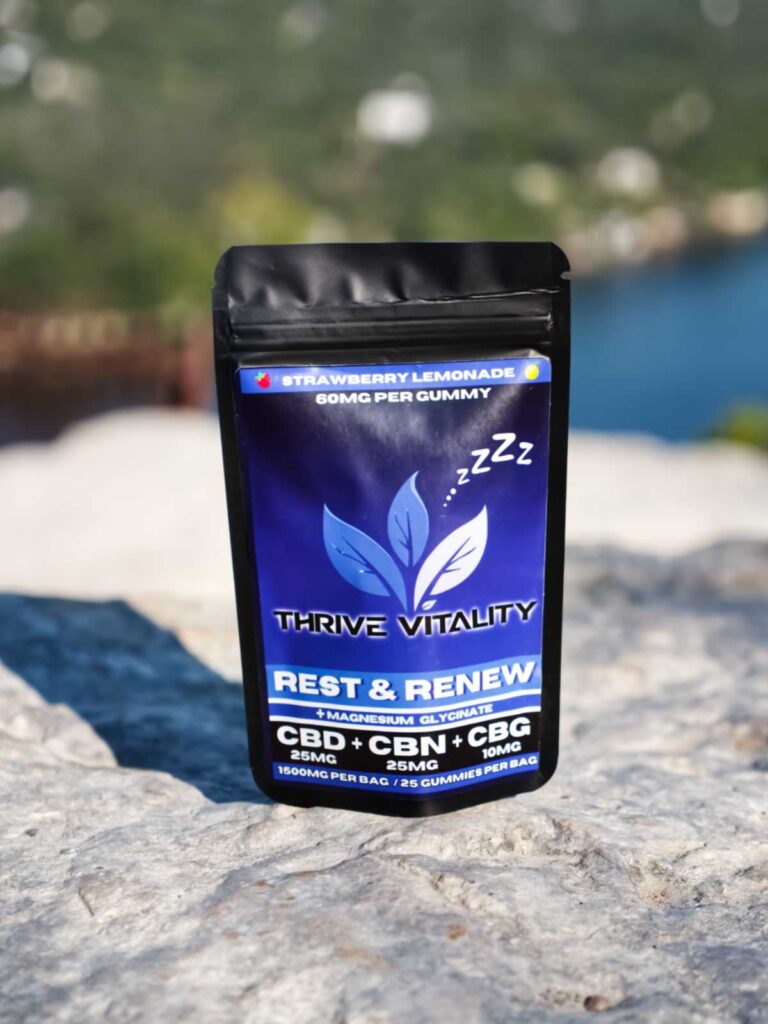
You’ll find examples of these COAs across Thrive Vitality’s product pages, such as the Rest & Renew Sleep Gummies, which clearly list cannabinoid content and safety test results.
Where to Find COAs for Thrive Vitality Products
: Example :

We make it easy to access lab results in multiple ways:
- Scan the QR code printed on every product label
- Visit our Lab Testing Results page
Need a refresher on CBD science and terminology? Start with our Intro to CBD & Cannabinoids guide.
How to Read a Lab Report Like a Pro

If you’ve never looked at a COA before, here’s how to interpret the key data points:
CBD content: The report should show a total milligram count that aligns with what’s on the product label. For example, Active Relief Daytime Gummies are third-party verified for CBD dose accuracy.
THC levels: For legal hemp CBD, delta-9 THC must be under 0.3%. Broad-spectrum or isolate products should list THC as “ND” (non-detectable).
Contaminants: Look for “ND” next to heavy metals (lead, arsenic), microbial agents (E. coli, salmonella), and residual solvents.
Batch number and date: This must match the physical product and should be dated within the last 6–12 months for freshness and safety assurance.
Why Not All Lab Reports Are Created Equal
⚠️ Be cautious with products that:
🚫 Don’t show a COA
If there’s no Certificate of Analysis available, assume there’s something to hide.
❓ Include vague or incomplete lab results
Watch out for results that don’t clearly show cannabinoid levels.
🔍 Are missing key fields like lab name, test date, or batch number
A real COA must be specific to the exact product batch you’re shopping.
These are all signs that a brand may not prioritize transparency or compliance.
What Thrive Vitality Does Differently
At Thrive Vitality, quality isn’t just a buzzword—it’s our standard. Every item we offer, from Hemp Salve Topical to our high-strength gummies, each coming with a # batch-specific COA.
Most brands stop at the basics. We don’t. At Thrive Vitality, we raise the bar for quality, safety, and transparency through every stage of production.
- Using organic, non-GMO hemp grown without synthetic pesticides
- Conducting full-spectrum cannabinoid verification on every batch
- Ensuring potency and safety consistency across all product lines
- Publishing batch-specific COAs with every product we sell
This is the place to be if you’re looking to support better natural daily recovery as part of your active lifestyle or improving your sleep with our CBD option, possibly enhancing your wellness goals.
Final Thoughts: Trust Is Built on Testing
With third-party testing, you’re not just trusting a label—you’re trusting data. When a product is truly lab-certified, you can verify that it meets every standard for legal compliance, consumer safety, and label accuracy.
Before you buy any CBD product, ask yourself:
- Can I easily find the COA?
- Is the hemp organically grown and pesticide-free?
- Does the report confirm cannabinoid content and safety?
- Is the testing lab clearly listed and independent?
If the answer to all four is yes—you’re buying from a brand that values transparency.
🛍️ Ready to shop smarter?