
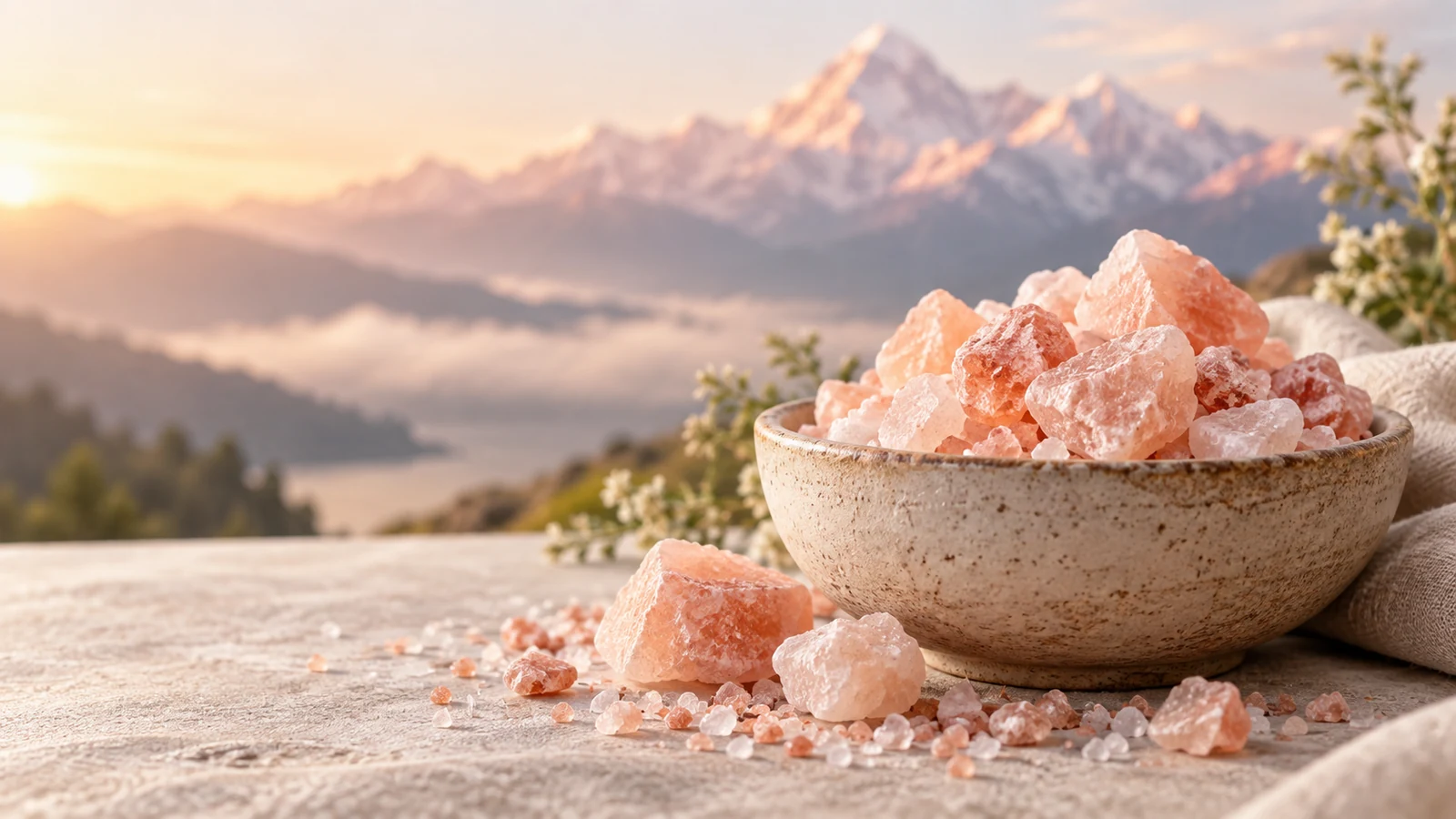
The Mineral Library / No. 03
Himalayan Salt
Himalayan salt is rock salt that formed from an ancient sea, mined in Pakistan’s Salt Range and tinted pink by trace minerals. In a soak it brings texture, color, and a classic salt-bath feel, while magnesium-rich minerals do the heavy lifting.
INCI Name
Sodium Chloride (Himalayan Pink Salt)
Origin
Salt Range, Punjab, Pakistan
Mineral Character
Pink rock salt, about 96–99% sodium chloride
Role in Blend
Texture, color, and classic salt-bath body
01 What Himalayan Salt Is
Himalayan salt is rock salt: sodium chloride that crystallized from an ancient sea and was buried for hundreds of millions of years. The best-known source is Khewra, in the Salt Range of Punjab, Pakistan, roughly 300 km from the Himalayas. The name is trade shorthand rather than a precise address.
Geologists date the deposit to roughly 540 to 600 million years ago, when a shallow, sun-baked sea evaporated and left thick salt beds behind. Khewra has been worked for centuries and is operated today by Pakistan’s state Mineral Development Corporation.
Its pink-to-orange color comes from trace minerals in certain veins, including iron and bands of potassium-magnesium minerals. Independent lab analysis puts it at about 96 to 99 percent sodium chloride, with small, variable amounts of calcium, potassium, magnesium, and sulfur.
02 Why It Belongs in a Mineral Soak
Himalayan salt dissolves into the classic salt-bath feel people recognize, and its coarse pink crystals make the ritual visible before the water is even run. That sensory cue matters. Research on evening warm baths points to the comfortably warm water itself, so the value of any soak salt is in how it shapes the experience.
What it does not bring is meaningful magnesium. Per gram, Epsom salt carries roughly 35 times as much, and magnesium chloride roughly 45 times. That is why we treat Himalayan salt as a supporting ingredient and build the mineral character of our soaks around magnesium-rich salts.
Pink salt is beautiful, and it is mostly sodium chloride. We use it for what it does well and let magnesium-rich minerals carry the mineral story.
In Relax & Restore, Himalayan salt joins magnesium chloride and Epsom salt to give the blend body, texture, and its soft pink color.
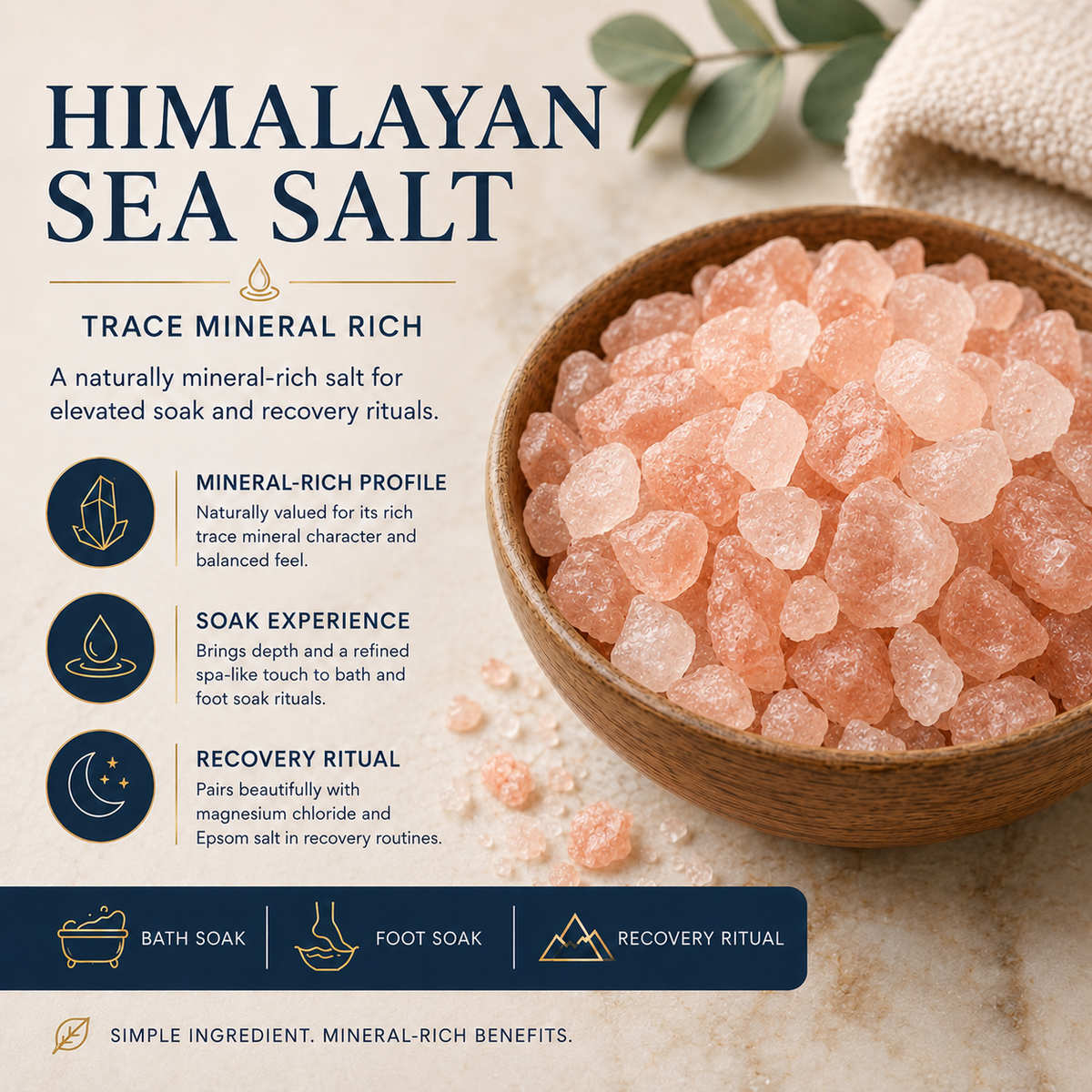
Coarse Himalayan salt crystals bring texture, color, and a familiar salt-bath feel to the blend.
03 Three Roles in the Formula
Texture and body
Coarse pink crystals give the blend weight in the hand and a familiar salt-bath feel once dissolved.
Natural color
Trace minerals give the crystals their soft pink tone, so the blend looks as considered as it feels, with no added colorants.
A familiar ritual cue
Many people already connect pink salt with a slow, restorative bath, which makes the ritual easy to begin.
Formulation Note
We specify coarse, low-moisture Himalayan salt with a lot-specific certificate of analysis covering sodium chloride content, insoluble matter, and heavy metals. Deeper pink is not a mark of quality. Darker crystals often carry more insoluble residue, not more magnesium.
04 Himalayan Salt, Epsom Salt, and Magnesium Chloride
All three dissolve into a warm soak, but they are chemically different. The difference that matters most is magnesium.
Swipe to compare
| Himalayan Salt | Epsom Salt | Magnesium Chloride | |
|---|---|---|---|
| Chemistry | Sodium chloride, NaCl | Magnesium sulfate, MgSO₄·7H₂O | Magnesium chloride, MgCl₂·6H₂O |
| Mineral form | Pink rock-salt crystal | Heptahydrate crystal | Hexahydrate flake |
| Elemental Mg by mass | About 0.1–0.35% | About 9.9% | About 12% |
| In warm water | Dissolves; may leave trace mineral residue | Dissolves readily | Dissolves readily |
| Role in our blend | Texture, color, and salt-bath body | Familiar magnesium-sulfate base | Dead Sea magnesium-chloride component |
The useful distinction: Himalayan salt shapes how the soak looks and feels, while Epsom salt and magnesium chloride supply the magnesium. Together, each salt does the job it is best at.
The Mineral Library
Three salts, one blend
Relax & Restore combines three mineral salts selected for distinct compositions and complementary roles.
Current guide
Himalayan Salt
Ancient rock salt, pink mineral color, and its supporting role in a soak.
05 How to Use the Mineral Soak
- Run the water comfortably warm. Use a temperature that feels good to your skin.
- Add roughly a half cup per standard tub. Pour the crystals under running water so the blend disperses.
- Soak for 15 to 20 minutes. Adjust the time if your skin feels uncomfortable.
- Rinse briefly, then pat dry. Leave skin slightly damp before applying a favorite body oil or balm.
- For a foot soak, use a quarter cup. Add it to a comfortably warm basin and stir until dissolved.
For external use only. Avoid broken or actively irritated skin, and stop if stinging or irritation develops. If you are pregnant, have reduced heat sensation, or manage a skin or medical condition, ask your clinician whether a mineral soak fits your situation.
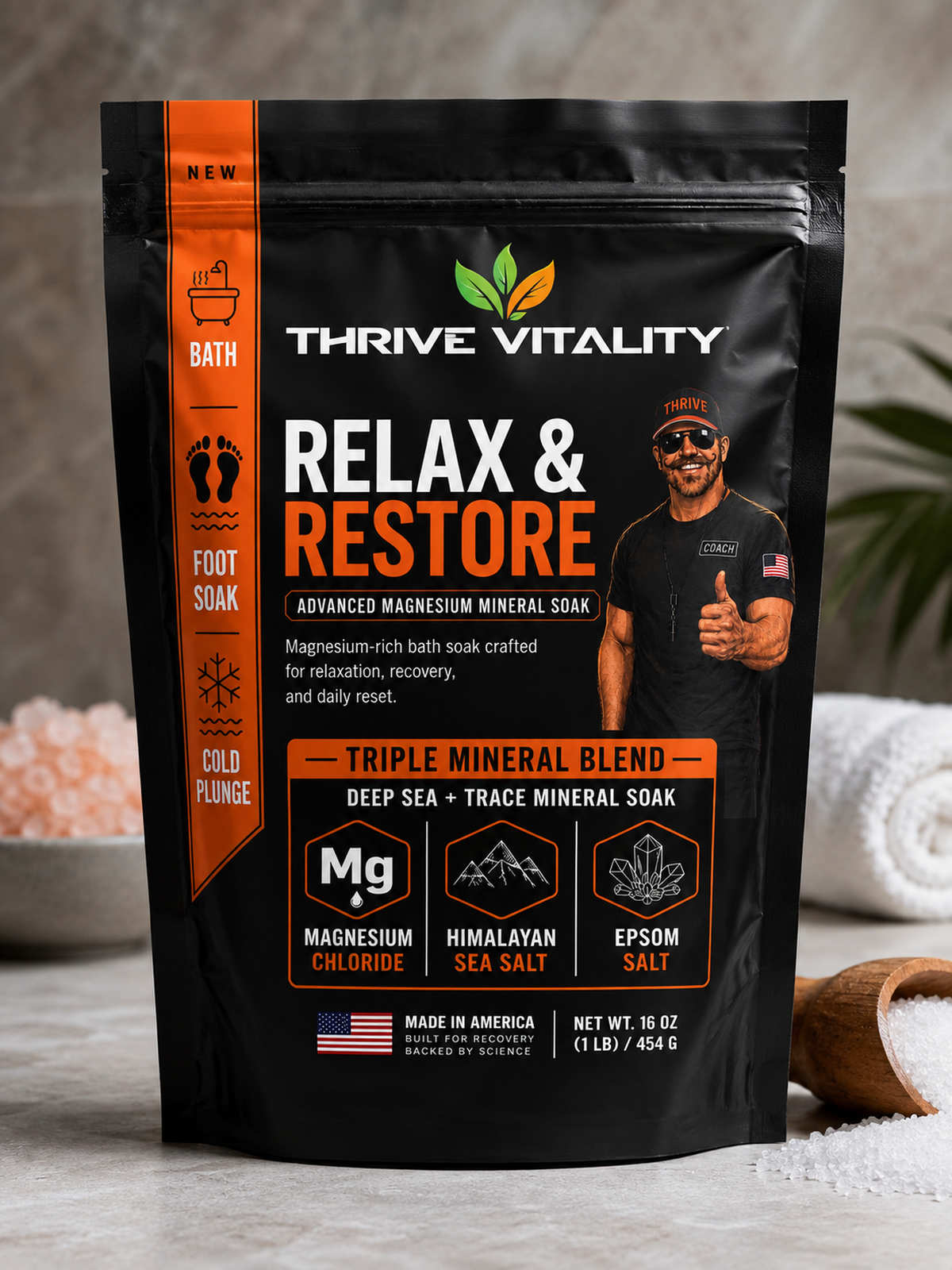
Relax & Restore pairs Himalayan salt with Dead Sea magnesium chloride and Epsom salt.
For Wholesale & Private Label Partners
The buyer’s specification
For spa menus, hotel amenities, gym retail, and private-label lines, specify Himalayan salt the way you would any active ingredient: by origin, grain, and documented testing.
INCI
Sodium Chloride (Himalayan Pink Salt)
Origin
Khewra, Salt Range, Pakistan, with lot traceability
Grain
Coarse 2–5 mm, washed, low moisture
Documentation
Lot COA: sodium chloride, insolubles, heavy metals
Relax & Restore is blended and filled in the USA. A fragrance-free option supports programs that want the same mineral base without added scent.
Common questions
Is Himalayan salt actually from the Himalayas?
Not exactly. Most Himalayan salt is mined at Khewra, in the Salt Range of Pakistan’s Punjab province, south of the Himalayan mountains. The deposit formed from an ancient sea, not from the mountains themselves.
Does pink salt contain 84 minerals?
The “84 minerals” figure comes from retailer tables without a published lab method, and many listed elements are below detection or are contaminants rather than nutrients. Independent analysis shows Himalayan salt is about 96 to 99 percent sodium chloride, with small amounts of other minerals.
Is Himalayan salt a good source of magnesium?
No. It averages well under half a percent magnesium by weight. In our soaks, magnesium comes from magnesium chloride and Epsom salt, while Himalayan salt contributes texture, color, and body.
Why is it pink?
Trace minerals in certain salt veins, including iron and potassium-magnesium mineral bands, give the crystals their color. A deeper pink does not mean more magnesium.
Is it suitable for the bath?
Yes, for external use. Use comfortably warm water, avoid broken or irritated skin, rinse if irritation develops, and keep salts out of jetted tubs, hot tubs, and cold-plunge equipment unless the manufacturer approves them.
Is there a fragrance-free option?
Yes. Choose the fragrance-free formula if scent or essential oils are not part of the experience you want.
Meet the triple-mineral blend
Relax & Restore Advanced Magnesium Mineral Soak combines Epsom salt, Dead Sea magnesium chloride, and Himalayan pink salt. One 16 oz package makes four to six soaks.
References
- Fayet-Moore F. et al. (2020). An analysis of the mineral composition of pink salt available in Australia. Foods, 9(10), 1490. Source
- Richards L. et al. (2021). Dating the Salt Range evaporites of Pakistan. Geochronology, 3, 545–559. Source
- Gröber U., Werner T., Vormann J., Kisters K. (2017). Myth or reality: transdermal magnesium? Nutrients, 9(8), 813. Source
- Haghayegh S. et al. (2019). Before-bedtime passive body heating by warm shower or bath to improve sleep. Sleep Medicine Reviews, 46, 124–135. Source
This article is provided for general education. Thrive Vitality products are cosmetics intended for external use and are not intended to diagnose, treat, cure, or prevent any disease. Statements about skin feel and ritual describe cosmetic and sensory use.