The Mineral Library No. 01
Magnesium Chloride
Magnesium chloride is a mineral salt used in our triple-mineral soak. This guide explains its form, its role in bath water, and the limits of the evidence.
INCI Name
Magnesium Chloride
Form Used
Hexahydrate flake
MgCl₂·6H₂O
Origin
Dead Sea solar
evaporation ponds
Role in Blend
Mineral salt
in our blend
01 What Magnesium Chloride Is
Magnesium chloride is a mineral salt — one magnesium ion bound to two chloride ions. In its cosmetic form it arrives as a translucent flake that carries six molecules of water locked into its crystal structure, which is why chemists write it as MgCl₂·6H₂O and call it the hexahydrate.
Magnesium chloride hexahydrate can absorb moisture from the air. In warm bath water, the flakes dissolve readily.
Magnesium chloride can be produced from seawater, subsurface brine, or carnallite. The source and processing method affect the final raw-material specification.
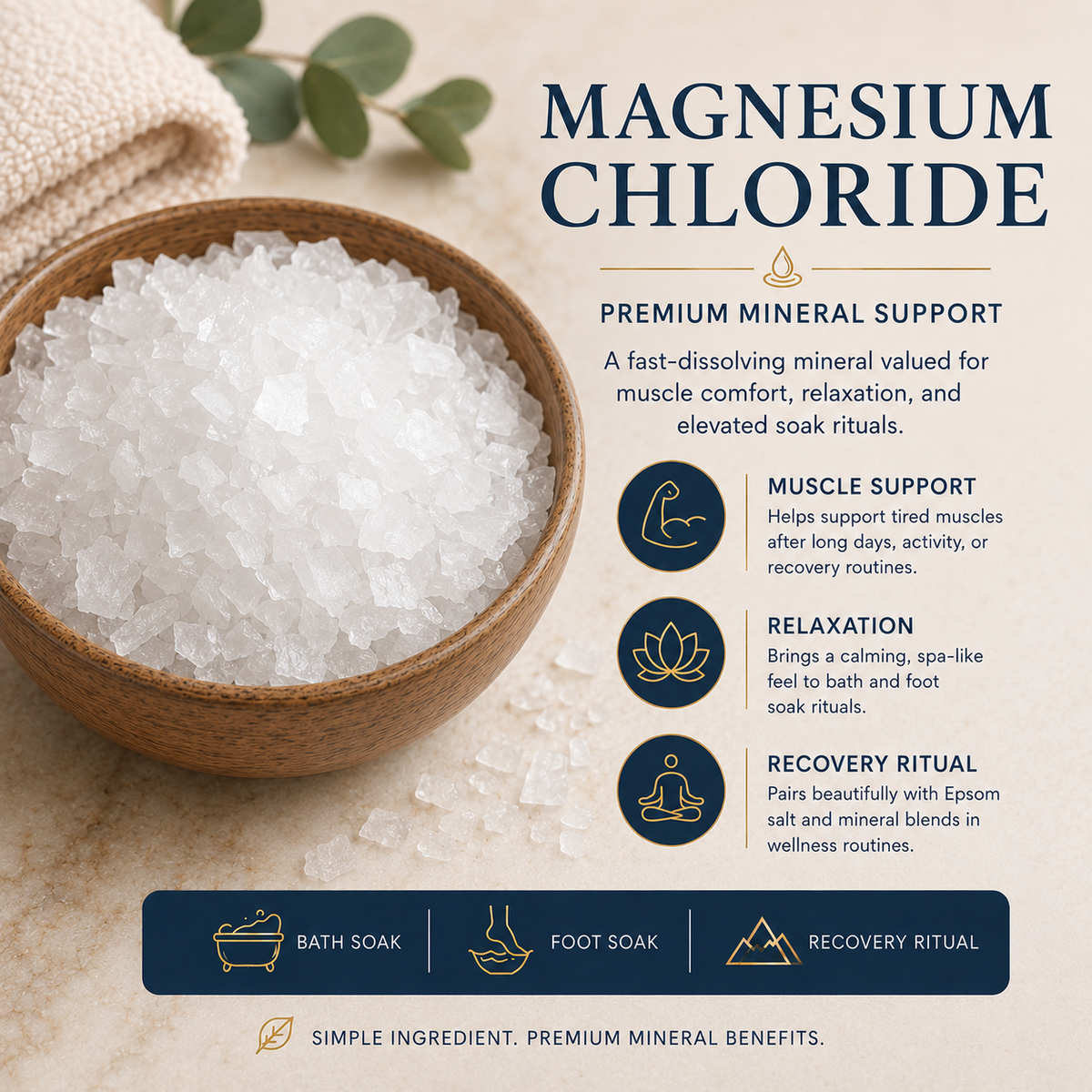
Magnesium chloride hexahydrate: the crystal carries six water molecules in its structure.
02Why the Dead Sea, specifically
The Dead Sea is not a sea. It is a terminal lake sitting at the lowest exposed point on Earth, fed by mineral-rich runoff with no outlet but evaporation. Water leaves, minerals stay. Over millennia that has produced a body of water roughly ten times more concentrated in dissolved salts than ordinary ocean water.
Dead Sea brines differ from ordinary ocean water because their dissolved-mineral balance contains proportionally more magnesium and potassium salts and less sodium chloride. Exact composition varies by location, season, and processing method; the ranges stated here refer to the supplier specification for the raw material used in this formula.
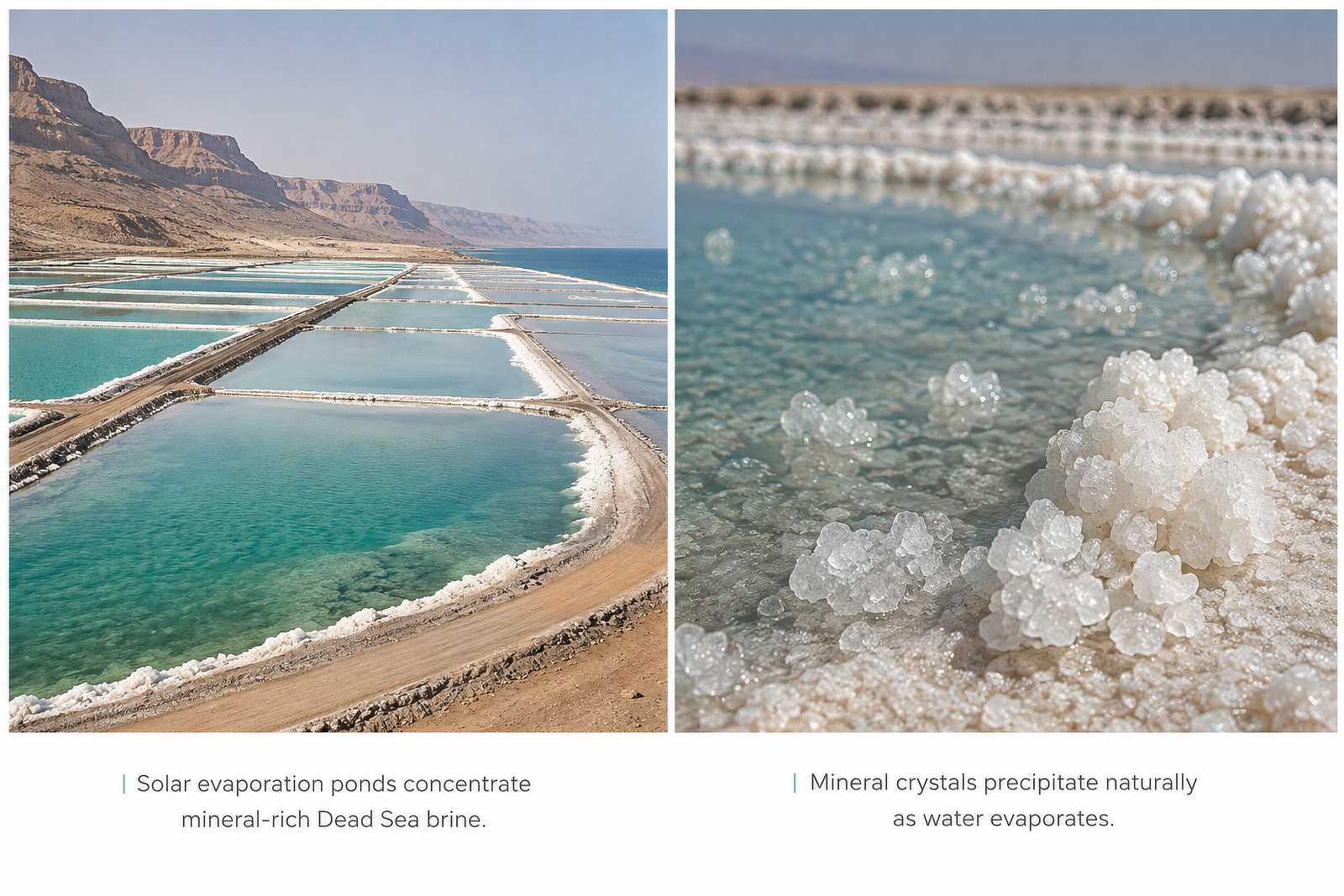
Solar evaporation ponds concentrate Dead Sea brine until mineral crystals precipitate.
The source and chemical form of a mineral salt matter to its raw-material specification.
Solar evaporation concentrates Dead Sea brine before minerals are separated and processed. Refer to the supplier specification for the composition of the magnesium chloride flakes used in this formula.
03How magnesium chloride behaves in bath water
Magnesium chloride dissolves readily in warm water. Its crystalline form and high solubility make it a practical mineral salt for a bath soak.
A soluble mineral salt, not a water softener
In technical terms, dissolved calcium and magnesium contribute to water hardness, so magnesium chloride does not soften bathwater. It changes the mineral composition of the water and may contribute to the sensory character of a mineral soak.
What the study actually found
A controlled study published in the International Journal of Dermatology tested a 5% magnesium-rich Dead Sea salt solution. Volunteers submerged one forearm for fifteen minutes, with the other forearm in tap water as the control. Over six weeks, the tested solution was associated with higher skin hydration and changes in selected skin measurements compared with tap water.[1]
This was a modest study of a specific salt solution and population. It does not establish that every magnesium-chloride soak will produce the same result, and it does not support claims about systemic magnesium absorption or treating medical conditions.
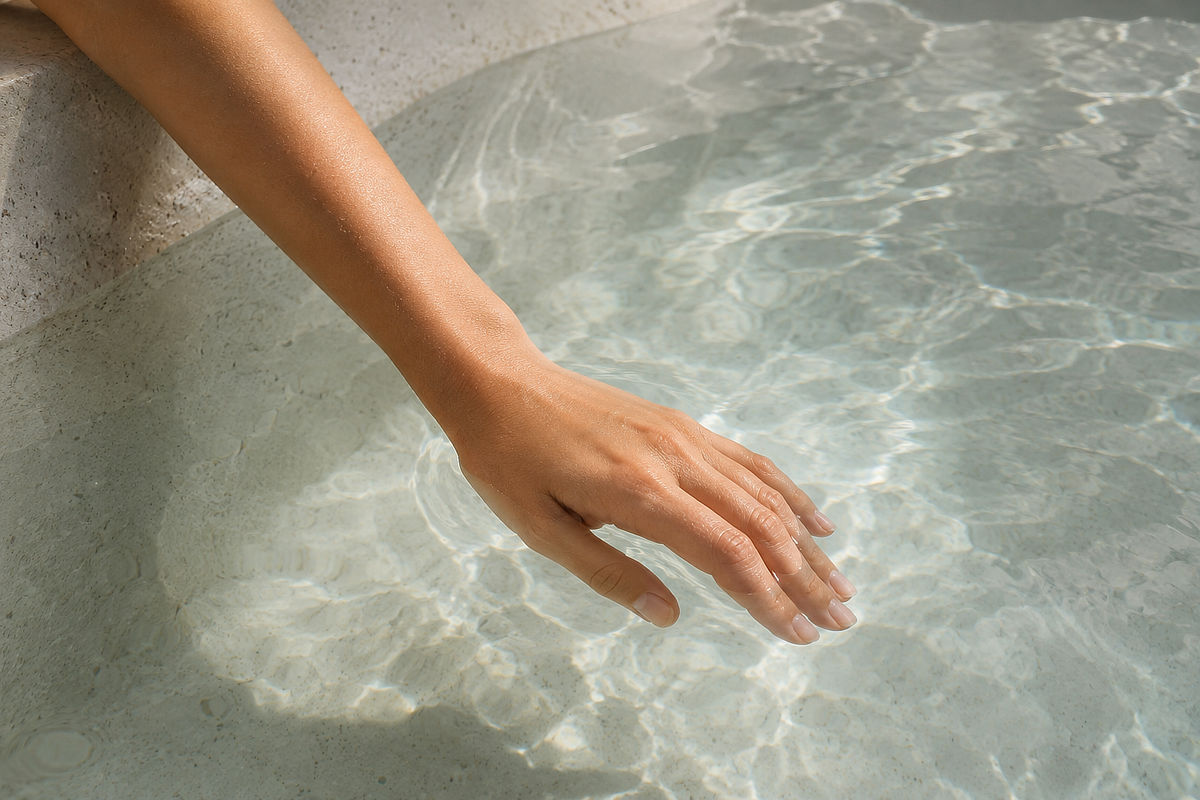
The cited study assessed hydration and selected skin measures for a tested Dead Sea salt solution.
04Magnesium chloride, Epsom salt, and the blend
Magnesium chloride and Epsom salt are different magnesium salts. Our formula uses both alongside Himalayan pink salt because each has a distinct composition and role in the blend.
Swipe to compare
| Magnesium Chloride | Epsom Salt | |
|---|---|---|
| Chemistry | MgCl₂ · 6H₂O | Magnesium sulfate, MgSO₄ · 7H₂O |
| Typical source | Dead Sea brine, solar-harvested | Mined or manufactured |
| Solubility | High; readily dissolves in warm water | High; dissolves in warm water |
| Elemental Mg by weight | ~12% (hexahydrate) | ~10% (heptahydrate) |
| Why we use it | Selected for mineral profile and dissolving behavior | Selected as a complementary magnesium salt |
Our Relax & Restore Advanced Magnesium Mineral Soak combines magnesium chloride, Epsom salt, and Himalayan pink salt. We select these three salts for their different compositions and sensory roles in the formula; none is a replacement for the others.
The Mineral Library
Three salts, one blend
This guide focuses on magnesium chloride. Epsom salt and Himalayan pink salt will each have their own guide, covering source, composition, and their role in the same blend.
Current guide
Magnesium Chloride
Mineral salt supplied as magnesium chloride hexahydrate flakes.
Coming soon
Epsom Salt
Magnesium sulfate and its place in a mineral soak.
Coming soon
Himalayan Pink Salt
Source, composition, and naturally pink mineral character.
05How to use a mineral soak
- Run the water comfortably warm. Choose a temperature that feels comfortable for your skin.
- Add roughly a half cup per standard tub. A 16 oz jar gives you four to six soaks. Add it under the running tap so it disperses.
- Soak for 15–20 minutes. Adjust the time if your skin feels uncomfortable.
- Rinse briefly, then pat dry. Do not scrub. Leave the skin slightly damp and, if you like, seal it with an oil or balm.
- Use it as part of your routine. Choose a frequency that feels comfortable for your skin.
For a foot soak, use a quarter cup in a basin. Avoid broken or actively irritated skin, and stop if stinging or irritation develops. If fragrance or essential oils are a concern, choose our Fragrance-Free Formula.
For Wholesale & Private Label Partners
The buyer’s specification
If you are placing this on a spa menu, in a hotel amenity program, or under your own label, here is the ingredient information your team and your compliance reviewer will ask for.
Chemical Form
Hexahydrate flake, MgCl₂·6H₂O
Origin
Dead Sea brine, solar evaporation pond harvested
Manufacturing
Blended and filled in the USA
Documentation
Available on request for qualified wholesale and private-label partners
The fragrance-free formula gives programs that prefer a no-fragrance option a way to offer the same mineral base. Private label partners receive the same mineral base under their own mark, with Manufactured for [Client] by Thrive Vitality on the panel.
Common questions
Is magnesium chloride the same as magnesium supplements?
No. Oral magnesium supplements are regulated as dietary supplements and are intended to be swallowed. Magnesium chloride in a mineral soak is a cosmetic ingredient used topically in water. They are different products, different regulatory categories, and different purposes. A mineral soak is a skin and ritual product.
Will it suit dry or sensitive skin?
Not necessarily. In a controlled study, a 5% magnesium-rich Dead Sea salt solution improved hydration and selected barrier measures compared with tap water in adults with dry, atopic-prone skin.[1] That result does not guarantee that every salt product will suit every user. Use comfortably warm water, keep the soak brief, and stop if irritation develops.
Why does the jar feel slightly damp?
Because magnesium chloride is hygroscopic — it pulls moisture from the air. A little clumping or a faintly moist texture is the mineral behaving exactly as it should. Keep the lid sealed between uses and store it out of a steamy shower’s direct path.
Can I use it if I am pregnant or have sensitive skin?
Choose the fragrance-free formula if scent or essential oils are a concern. Avoid use on broken or actively irritated skin, and stop if the product stings or causes irritation. If you are pregnant, have reduced heat sensation, or manage a skin or medical condition, ask your clinician whether a mineral soak fits your situation.
Does it stain or damage a tub?
The salts are designed to dissolve in bath water. Rinse the tub after use, particularly with the scented formula, and follow your tub manufacturer’s care instructions.
Meet the triple-mineral blend
The Relax & Restore Advanced Magnesium Mineral Soak — Dead Sea magnesium chloride, Himalayan pink salt, and Epsom salt. 16 oz. Four to six soaks.
References
- Proksch E, Nissen HP, Bremgartner M, Urquhart C. “Bathing in a magnesium-rich Dead Sea salt solution improves skin barrier function, enhances skin hydration, and reduces inflammation in atopic dry skin.” International Journal of Dermatology, 2005;44(2):151–157. PMID 15689218.
- Gröber U, Werner T, Vormann J, Kisters K. “Myth or Reality—Transdermal Magnesium?” Nutrients, 2017;9(8):813.
- Dead Sea salt mineral composition ranges per supplier technical specification for the raw material used in this formula.
- U.S. Geological Survey. Hardness of Water.
This article is provided for general education. Thrive Vitality products are cosmetics intended for external use and are not intended to diagnose, treat, cure, or prevent any disease. Statements about skin feel and skin conditioning describe cosmetic effects.